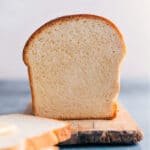
White Bread
My favorite go-to White Bread recipe uses just six simple ingredients you probably already have! No grocery run needed—just soft, fresh bread ready to enjoy.
Servings: 2 loaves (24 slices)
Cost: $2.35
Equipment
- 2 8.5 x 4.5-inch bread pan or 2 (9 x 5-inch) bread pans
Ingredients
- Cooking spray olive or coconut oil
- 2 cups warm milk see note 1
- 1 tablespoon active dry yeast or instant yeast, see note 2
- 1/2 cup honey
- 6-1/2 cups all-purpose flour or bread flour, divided, see note 3
- 1 tablespoon salt see note 4
- 6 tablespoons unsalted butter melted and cooled
- 1 teaspoon granulated sugar optional
- 2 tablespoons butter optional
Instructions
- If using instant yeast: In the bowl of a stand mixer, add the warm milk (see note 5; if it is too hot, it will burn the yeast). Add instant yeast and 1 teaspoon white sugar (optional) directly on top and stir to combine. Let stand 3 minutes. Skip to step 3.
- If using active dry yeast: In the bowl of a stand mixer, add the warm milk (see note 5; if it is too hot, it will burn the yeast). Sprinkle active dry yeast over the milk and the sugar (if using). Stir, then let stand 5–10 minutes or until yeast is foamy. If yeast doesn’t foam up, it is dead (either bad yeast or too hot of milk). You’ll want to dump everything out and start again; otherwise the bread won’t develop properly.
- Pour in honey and 2 cups (260g) flour. Use the beater blade to stir just until the flour is moistened, about 1 minute, scraping the sides with a spatula as needed. Let mixture sit undisturbed 10 minutes.
- As the mixture sits, melt 6 tablespoons butter in the microwave. Let butter cool to room temperature (it’s important it’s not even warm!), then stir in 1 tablespoon salt. Set aside.
- Once dough has sat 10 minutes, add in melted and cooled butter/salt mixture (use a spatula to scrape every bit into the stand mixer). Add 4 more cups (495g) flour (see note 6). Swap to a dough hook. Stir on low speed (speed 2) until mixture is all combined and begins to gather around the dough hook (about 2–3 minutes). If dough is sticking to the sides, gradually add in remaining 1/2 cup (60g) flour. You can continue to add a little more flour, up to 1 tablespoon at a time, but avoid adding too much extra flour unless it really is too sticky (still sticking on edges of bowl instead of collecting around dough hook).
- Once dough has gathered around dough hook, increase speed to medium (speed 4–6) and mix 10 minutes. Don’t go too far; your stand mixer might dance off the table. (If you don’t have a stand mixer, you can knead the dough by hand for about 10–12 minutes). We are looking for a dough that is smooth, satiny, soft, and tacky to the touch (but not sticky or dry).
- Once dough has been kneaded, place it on a clean work surface. Knead with your hands for about 20 seconds to shape it into a large even ball. Generously grease the mixing bowl with coconut or olive-oil-based spray. Place dough in the bowl and turn it to coat in the oil. Cover dough with a damp cloth and place bowl in a warm place (~70℉) to rise until it doubles in size, about 1 hour.
- Remove damp cloth and punch into the dough to release the air. Divide the dough into 2 equal parts (I recommend a food scale to make sure you’ve got the same amount of dough in each half). Shape dough into two loaves (see note 7) and place in greased 8.5x4.5-inch bread pans (see note 8). Cover pans with a damp cloth and let them rise in a warm place for another hour or until about doubled in size. Do not let bread rise longer than needed; this will cause the bread to develop a yeasty taste.
- Bake at 375℉ 32–40 minutes (see note 9). Right out of the oven, optionally rub remaining 2 tablespoons butter on the tops of the loaves. Let bread cool in the pan 10 minutes. Then transfer to a wire cooling rack and let cool for at least 30 minutes before slicing. (The bread is still cooking even out of the oven.) Slice and serve.
Video
Notes
Note 1: I use and recommend whole milk, although 1%, 2%, and skim all work fine.
Note 2: Ensure yeast is alive/active before using. Yeast produces and feeds best at around 105–115℉. If the yeast doesn’t prove, this can be because the yeast is old, the milk was too hot, or the milk/environment is too cold.
Note 3: Either all-purpose or bread flour works! Bread flour has more protein than all-purpose flour, which helps with the bread’s gluten development and yields chewier bread. You may need a touch less bread flour than all-purpose.
Note 4: Not all salts have the same amount of sodium. I tested with fine sea salt; if using table salt, you’ll want to use slightly less. Yes, it sounds like a lot, but it’s important for flavor and gluten structure!
Note 5: How to tell your milk is at the right temperature: Drizzle a few drops of the warmed milk onto the inside of your wrist. If it is warm and comfy, it will be perfect for the yeast. If it feels hot, it will be too hot for the yeast. Too cold and the yeast will simply remain dormant.
Note 6: Adding the flour can be tricky. Humidity, altitude, and temperature can all factor in to how much flour you need. I recommend starting with 1/2 cup shy of what a recipe calls for and adding slowly until the dough pulls off the sides of the bowl and is not excessively sticky. We don’t want wet dough, but it should still have moisture. Too much flour results in a dense and less-flavorful bread. When measuring flour, be sure to weigh flour or spoon and level. If you press a measuring cup into a container and push flour into the cup, you’ll end up with way too much flour.
Note 7: To shape loaves, roll dough with a rolling pin into a rectangle, then roll it up tightly into an even cylinder, pinching the seams and tucking the sides into the dough.
Note 8: Either size 8.5x4.5-inch or 9x5-inch bread pans works, but I recommend the 8.5x4.5-inch pans for a higher rise.
Note 9: You know bread is done when it read registers 195℉ in the center. It should have an evenly covered golden brown crust that looks firm and dry. If you tap the loaf in the center with your knuckles it should sound hollow (if not, bake 5 more minutes and try again).
Storage: Store leftover bread at room temperature in a cool, dry place 3–5 days, preferably in a container that allows some ventilation so the bread can “breathe.” I don’t recommend storing it in the fridge, as it turns stale quickly. To keep bread soft, store it in an airtight plastic bag after it has completely cooled. After 2–3 days, I recommend storing it in the freezer, where it will keep for 3 months. Slice it before freezing, and transfer slices straight from the freezer to the toaster or thaw at room temperature.
Nutrition
Serving: 1serving | Calories: 179kcal | Carbohydrates: 32.9g | Protein: 4.4g | Fat: 3.3g | Cholesterol: 8mg | Sodium: 300.9mg | Fiber: 1.1g | Sugar: 6.9g