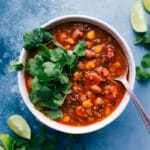
Quinoa Vegetable Soup
This Quinoa Vegetable Soup is a hearty, flavor-packed dish with veggies, shredded chicken, quinoa, and a tasty spice blend. Make it easily in your Instant Pot or slow cooker!
Servings: 6 servings
Cost: $9.93
Equipment
- 6-quart Crock-Pot or an Instant Pot
Ingredients
- 2 tablespoons olive oil
- 1/2 cup finely diced yellow onion
- 1/2 cup thinly sliced carrots
- 1/2 cup sliced celery
- 2 teaspoons minced garlic
- 1 (6-ounce) can tomato paste
- 1 (14.5-ounce) can fire-roasted crushed tomatoes or diced tomatoes
- 1 (16-ounce) pound boneless, skinless chicken thighs or breasts, see note 1
- 1 (15.5-ounce) can pinto beans drained and rinsed
- 1-1/2 cups frozen corn or 1 can
- 3/4 cup tri-colored quinoa or plain
- 1 large orange
- 5 cups chicken stock or broth, I like Swanson’s
- 2 bay leaves
Seasonings
Instructions
- Optionally sauté veggies (adds loads of flavor—see note 4): In the base of a slow cooker that can sauté, an Instant Pot insert, or a sauté pan, add the olive oil and heat over medium-high. Once oil is hot, add onion, carrot, and celery. Sauté, stirring frequently, until golden, about 5–7 minutes. Add garlic, tomato paste, and all the seasonings. Season to taste with salt and pepper (I add 1 teaspoon salt and 1/2 teaspoon pepper). Sauté, stirring frequently, until very fragrant and tomato paste starts to darken, about 5 more minutes. Pour in tomatoes and stir, scraping the bottom to release any browned bits (especially in an Instant Pot to avoid a burn warning).
- Meanwhile, trim the fat off the chicken. If using breasts, cut each breast into 3 large, even pieces.
- Slow Cooker: If you didn’t use a slow cooker to sauté, scrape every bit of the contents from the pan into the slow cooker. Add trimmed chicken, drained and rinsed pinto beans, undrained corn, uncooked (but rinsed—see note 5) quinoa, 1/2 cup orange juice, and bay leaves. Pour chicken stock over everything and mix well. Cover and cook on high 3–5 hours or until chicken is tender and shreds easily and quinoa has “popped” (my slow cooker takes closer to 3 hours). The longer it cooks, the more liquid the quinoa absorbs, which is why I don’t recommend cooking on low—see note 6.
- Instant Pot: Turn off sauté function and add trimmed chicken, drained and rinsed pinto beans, undrained corn, uncooked (but rinsed—see note 5) quinoa, 1/2 cup orange juice, and bay leaves. Pour chicken stock over everything and mix well. Put on the lid, set valve to “sealed,” and cook on manual for 10 minutes. Naturally release pressure for 7 minutes, then manually release the rest of the pressure (turn valve to “release”).
- Remove chicken and shred with 2 forks. Return shredded chicken to slow cooker or pressure cooker. Remove bay leaves and discard. Taste and season if needed with additional salt and pepper—flavors should sing!
- Ladle the soup into bowls and enjoy topped with your favorite toppings such as freshly shredded cheese, fresh cilantro, fresh lime, sour cream (I use low fat), etc.
Video
Notes
Note 1: I definitely prefer chicken thighs—the meat is much more tender and flavorful. That said, breasts work too. Cut breasts into smaller pieces so they’ll cook in time.
Note 2: I use McCormick Cajun seasoning, which tends to be a bit milder than other brands. Scale up or down to preference. Note that a lot of Cajun seasonings have salt added, so you may want less salt depending on the brand used.
Note 3: Optional Toppings: sharp Cheddar cheese, low-fat sour cream, fresh cilantro, fresh lime wedges or lime juice.
Note 4: The quick sauté of veggies and tomato paste adds amazing flavor and depth to the soup. It also ensures veggies are tender at the same time as the chicken and quinoa. If you opt to not sauté, you may want some extra seasonings, and be sure to very finely dice carrots, onion, and celery. (If you chose to skip this sauté step, simply add all those ingredients to the slow cooker or Instant Pot.)
Note 5: Quinoa has a naturally-occurring bitter coating on it, and it needs to be rinsed before adding. Many quinoas are pre-rinsed, so check the package to see if that's the case. If not, rinse quinoa in a fine-mesh sieve under cold water until the water runs clear.
Note 6: Quinoa will continue to absorb liquid as long as there is liquid to absorb! When cooking this soup on low or in the Instant Pot, it does absorb more liquid, making this more of a stew than soup (It’s still so tasty!) If you’d like the soup thinner, simply stir through some additional chicken stock (to individual bowls) at serving time.
Nutrition Note: Calories will vary, depending on toppings you add to the soup. Current calculations are for the soup without toppings.
Storage: Let the soup cool, then store leftovers in an airtight container in the fridge for 3–4 days. Reheat on the stovetop or in the microwave, adding a splash of broth if needed.
Nutrition
Serving: 1serving | Calories: 220kcal | Carbohydrates: 23.5g | Protein: 17.2g | Fat: 7.2g | Cholesterol: 56.4mg | Sodium: 661.4mg | Fiber: 4.6g | Sugar: 7.9g