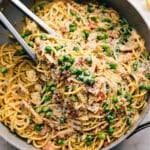
Chicken Carbonara Recipe
This Chicken Carbonara Recipe delivers big flavor with tender chicken, crisp bacon, and a smooth, classic sauce that feels so comforting!
Servings: 4 -6 servings
Cost: $12.27
Equipment
- Large skillet nonstick
Ingredients
- 2 medium boneless, skinless chicken breasts cut in half horizontally (1 pound)
- Salt and pepper see note 1
- 1/4 teaspoon garlic powder
- 1 tablespoon olive oil
- 2 tablespoons unsalted butter
- 8 slices bacon diced (8 ounces)
- 3 large eggs
- 3 large egg yolks
- 120 grams (4.25 ounces) finely shredded Parmigiano Reggiano about 1-1/4 firmly packed cups, see note 2
- 1 pound spaghetti
- 2 teaspoons salt
- 1 cup reserved pasta water
- 1-1/4 cups frozen peas optional
- 1 large lemon for serving, optional
- Fresh parsley for serving, optional
Instructions
- In a very large heatproof bowl, add eggs and egg yolks. Add 1/2 teaspoon pepper and whisk until smooth. Finely shred the cheese using the small holes of a grater or, preferably, a microplane. Weigh to be sure you have 120 grams. Whisk into the egg mixture until combined and set aside to get to room temperature.
- Slice the chicken breasts in half horizontally and pound lightly to an even thickness. Season both sides with 1/4 teaspoon salt, 1/4 teaspoon pepper, and 1/4 teaspoon garlic powder. In a very large nonstick skillet (one that can hold all the pasta later), add the butter and olive oil. Heat over medium-high. Once the butter is melted, add the four chicken pieces in an even layer. Cook for 3 minutes, flip, then cook another 2 to 4 minutes or until cooked through. Remove to a plate and set aside to rest.
- In the same skillet, add the bacon (still over medium-high heat). Cook until golden and the fat has rendered. Try to time this so the bacon finishes around the same time as the pasta. If not, remove the bacon with a slotted spoon and set aside. Then turn off the heat.
- Bring 14 cups of water to a rolling boil in a very large pot. Add 2 teaspoons salt, then cook the spaghetti until al dente according to package directions. Right before it’s done, give it a good stir, then pull out and reserve 1 cup of the pasta water. Do not drain the pasta.
- Use tongs to transfer the hot pasta directly from the pot into the pan with the bacon. Toss well so the pasta is coated in the rendered fat.
- Immediately transfer everything from the skillet into the bowl with the egg and cheese mixture. Stir vigorously for about 1 minute while gradually adding 1/2 cup of the hot pasta water, until the sauce becomes glossy and creamy. If needed, add more pasta water a little at a time until the sauce coats the pasta smoothly.
- Thinly slice, dice, or shred the chicken and add it to the bowl along with any juices from the plate. Add the peas, if using. Toss for about 1 more minute to warm everything through. Serve hot, garnished with fresh parsley and a squeeze of lemon, if desired.
Video
Notes
Note 1: Use table-grind pepper, not finely ground pepper. The coarser grind gives better texture and flavor in the sauce.
Note 2: This is the game-changing ingredient that takes a good carbonara to great. Use Parmigiano-Reggiano and grate it with a microplane, then weigh it since measuring can vary a lot. It’s a little extra work, but it pays off in a big way. In a pinch, Parmesan will also work; just be sure to weigh the final amount after grating.
Storage: Best eaten fresh.
Nutrition
Serving: 1serving | Calories: 996kcal | Carbohydrates: 74g | Protein: 75g | Fat: 42g | Saturated Fat: 16g | Polyunsaturated Fat: 5g | Monounsaturated Fat: 16g | Trans Fat: 0.2g | Cholesterol: 407mg | Sodium: 2178mg | Potassium: 916mg | Fiber: 4g | Sugar: 5g | Vitamin A: 1353IU | Vitamin C: 6mg | Calcium: 367mg | Iron: 4mg